A buyer’s guide to alternators and starters — New Service, factory-remanufactured (REMAN), and rebuilt units compared.
When an alternator or a starter motor fails on a commercial truck, bus or off-highway machine, the replacement decision is rarely a simple one. The same physical unit may be available on the counter as a brand-new factory build, as a factory-remanufactured (REMAN) assembly, or as a locally rebuilt unit — at three very different price points. The differences in process, quality control, performance and service life are significant and worth understanding before a purchase is made.
This article explains what each option actually is, how the three categories differ in measurable ways, and how to choose between them based on the application, the budget and the expected operating life of the vehicle. It uses Delco Remy (PHINIA) heavy-duty starters and alternators as the working example because the brand offers all three categories under one umbrella, but the principles apply to any rotating-electrics replacement decision.
The Three Options Explained
1. New Service Unit
A New Service alternator or starter is a brand-new assembly produced by the original equipment manufacturer. Every component — housing, rotor, stator, bearings, rectifier, voltage regulator, brushes, solenoid and drive — is new and built to the original engineering specification. The unit comes off the same production line, and is held to the same quality-control standards, as the alternator or starter fitted at the vehicle factory. Because nothing inside the assembly has any prior service life, a New Service unit offers the highest assurance of performance, the longest expected lifecycle, and the strongest factory warranty. It is also the most expensive of the three options.
2. Factory-Remanufactured (REMAN) Unit
A REMAN alternator or starter is a systematic, industrial restoration carried out — in Delco Remy’s case — by the OE manufacturer itself, in a dedicated facility using the same engineers, processes and test equipment that built the original. The process is far more than a clean-up of a used unit. A genuine factory REMAN typically involves:
- Complete disassembly of the returned core down to individual components.
- Industrial cleaning, inspection and dimensional checking of every hard part.
- Replacement of all wear and electrical items — bearings, brushes, voltage regulator, rectifier, slip rings, seals, solenoid contacts — with new OE-grade parts.
- Replacement of any hard part (housing, rotor, stator) that is found to be out of specification or corroded.
- Corrosion treatment, repaint and reassembly to the original torque and clearance specifications.
- Full bench testing of the finished unit to confirm output, regulation, and mechanical behaviour against the same standards used for a new unit.
The output is an assembly that performs equivalently to a new unit, often incorporates engineering improvements introduced since the original part was first built, and is sold at a meaningfully lower price than New Service. Delco Remy heavy-duty REMAN starters such as the 42MT typically carry an 18-month, unlimited-mile factory warranty in covered markets, which is a strong indicator of the manufacturer’s confidence in the rebuild.
Crucially, this category is only available because rotating-electrics have a high-value, long-life metal core. The core return system (explained later in this article) is what makes REMAN economically and environmentally viable.
3. Rebuilt Unit
A rebuilt alternator or starter is a unit that has been opened up, inspected, and had its visibly worn or failed parts replaced. The work is most often done by a local rebuilder rather than by the original manufacturer. Unlike a factory REMAN, the depth of teardown, the parts replaced, and the testing applied vary widely between one rebuilder and the next. Some rebuilders do excellent work; many do not. Even a careful rebuilder typically lacks the design data, the original test equipment and the access to engineering-improvement bulletins that an OE remanufacturer has.
The result is a unit that is usually the cheapest of the three options at the counter, but whose performance, lifecycle and reliability are unpredictable. Components that were not visibly worn at teardown may fail shortly after the unit is back in service, and warranties on rebuilt parts are typically short — often only 30 to 90 days — which itself tells you something about the confidence of the rebuilder.
Side-by-Side Comparison
The differences between New Service, REMAN and rebuilt units are easiest to see in a single table. The summary below is based on Delco Remy heavy-duty product specifications and on industry-standard remanufacturing practice.
| Attribute | New Service | REMAN (Factory) | Rebuilt |
|---|---|---|---|
| Components | 100% new parts, built to OEM specifications. | Housing and other non-wear hard parts reused; brushes, bearings, regulator, rectifier and other wear items replaced with new OE-grade parts. | Only visibly worn or failed parts replaced; many used parts retained. |
| Process | Standardised factory production line under OEM quality control. | Systematic industrial process: full disassembly, cleaning, inspection, replacement of all wear parts, corrosion treatment, full bench testing to OE specs. | Variable. Depends entirely on the rebuilder; often no formal teardown standard. |
| Quality | Highest possible — every component is new. | High and consistent. Tested to meet or exceed OEM specifications. | Inconsistent. Quality depends on the technician and the parts they choose to use. |
| Performance | Optimal output across the full duty cycle. | Equivalent to a new unit when sourced from an authorised OE remanufacturer. | Functional, but greater risk of premature output drop, vibration, or noise. |
| Expected Lifecycle | Longest. Full design life of all components. | Close to a new unit — typically 4–5 years or 60,000–100,000 km in normal duty. | Shorter and unpredictable due to the wear remaining in un-replaced parts. |
| Warranty | Longest factory warranty (e.g. up to 3–4 years/unlimited miles on certain Delco Remy school-bus alternators). | Strong factory warranty — Delco Remy REMAN starters typically carry 18 months / unlimited miles in covered markets. | Usually short (30–90 days) or none. Reflects the rebuilder’s own confidence. |
| Initial Cost | Highest. | Typically 25–40% less than New Service. | Cheapest upfront — but often the most expensive over the asset’s life. |
| Best for | Mission-critical applications, new vehicle builds, fleets where downtime cost > parts cost. | Out-of-warranty trucks, fleet maintenance budgets, sustainability-conscious buyers. | Very price-sensitive jobs on vehicles nearing end-of-life. |
How to Recognise a Genuine Delco Remy REMAN Unit
Counterfeit and mislabeled rotating-electrics are unfortunately common in the aftermarket. A genuine factory REMAN from Delco Remy can be identified by three visible features: the printed box, the box label and the identification tag on the unit itself. The photographs below show the markings to look for.
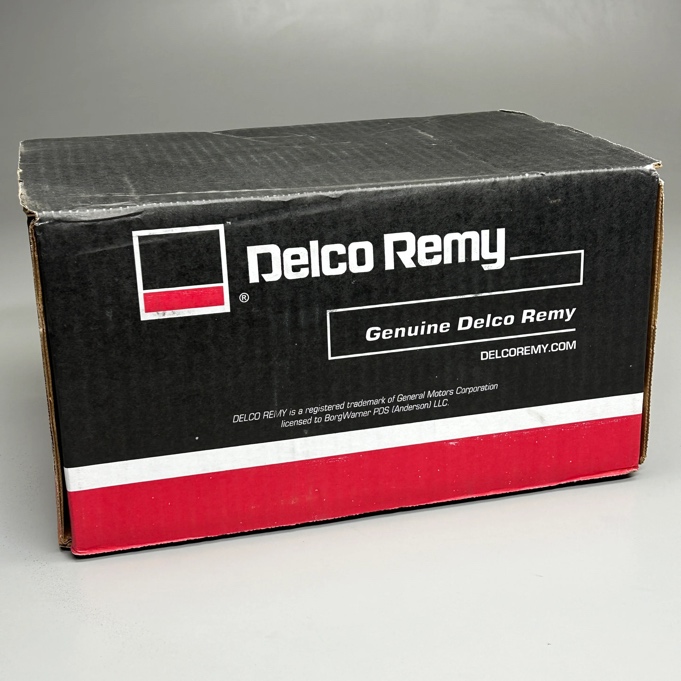
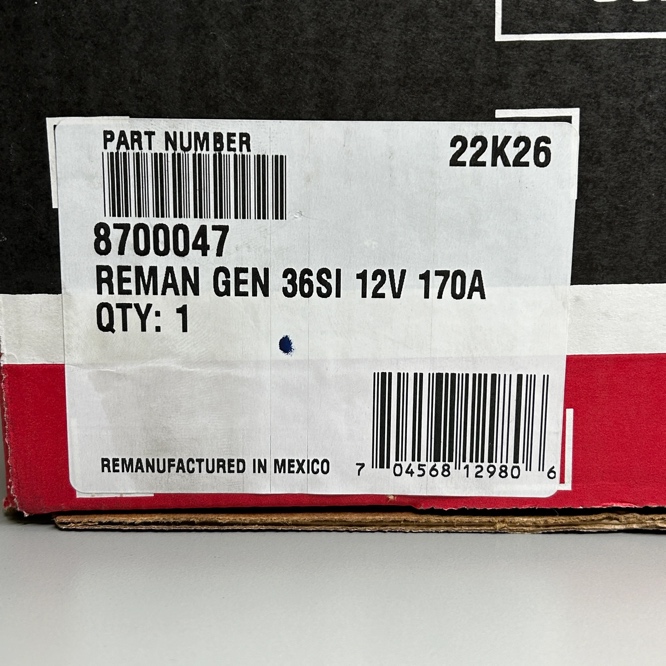
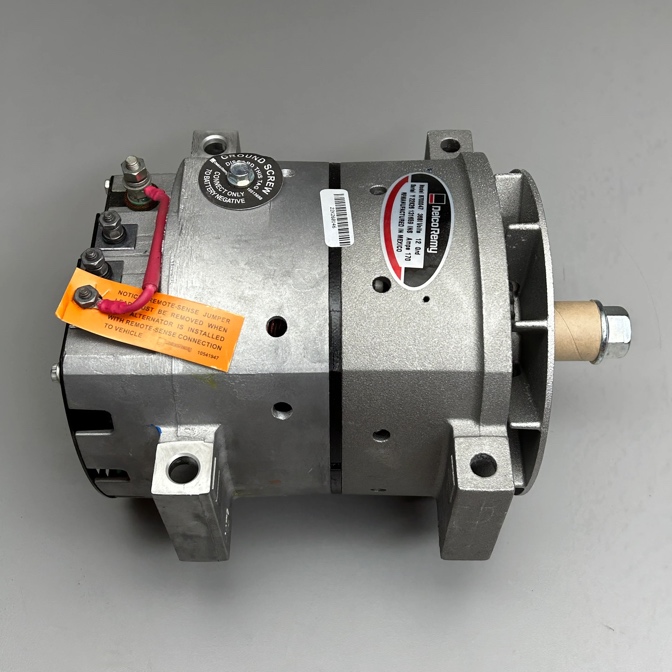
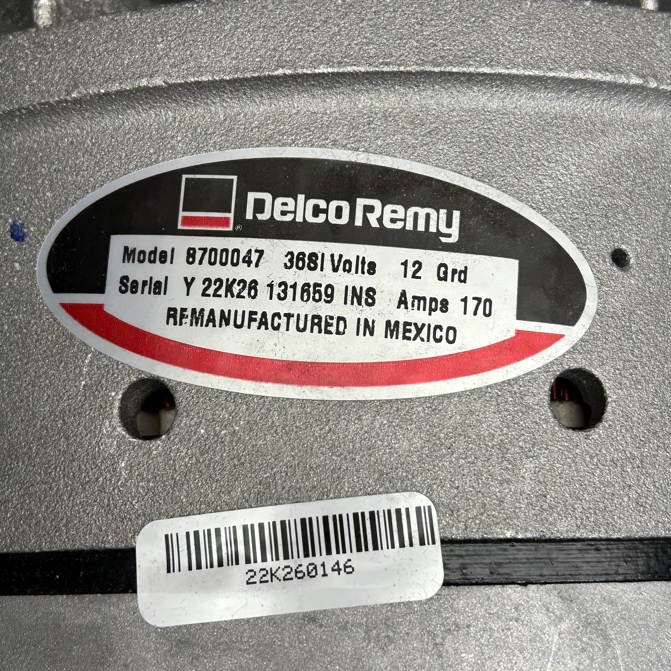
If any of these markings are missing, illegible or do not match between the box and the unit, the part should be treated as suspect. A genuine REMAN always carries clear factory identification because the part number and serial number are how the warranty claim — and the core return — are processed.
The Core Charge System
Anyone buying a remanufactured starter or alternator will encounter a core charge — sometimes also called a core deposit or core price. It is not a tax, a hidden margin, or a markup. It is a refundable deposit that exists to keep used rotating-electrics flowing back into the remanufacturing loop.
The mechanism is straightforward: at the time of purchase, the buyer pays the price of the new unit plus an additional core charge. When the buyer returns the old, failed unit (the “core”) in rebuildable condition, the core charge is refunded. The returned core then re-enters the factory to be cleaned, inspected, fitted with new wear parts and tested — to come out of the other end as another REMAN unit.
Two practical points are worth keeping in mind. First, the core must be returned promptly (most programmes require return within 30 days of purchase) and must be in rebuildable condition — that is, the same part number, complete, not disassembled, and not severely damaged. Salvage-yard cores or units missing major components are usually not accepted. Second, the core charge directly subsidises the price of every REMAN unit on the market. The reason a factory REMAN can cost 25–40% less than a New Service unit at comparable quality is precisely because the previous customer returned a core.
From a sustainability standpoint, the core system is significant. Industry data indicates that remanufacturing a rotating-electrics unit consumes up to 80% less energy than building one from raw materials, and it diverts large quantities of copper, steel and aluminium from scrap. For a fleet operator, choosing REMAN is therefore both a budget decision and an environmental one.
Choosing the Right Option for Your Application
There is no single answer that is correct for every vehicle or every operator. The choice depends on the duty cycle, the remaining life of the host vehicle, and how the operator values downtime against parts cost. The following guidelines are a starting point.
Choose New Service when:
- The vehicle is new or relatively new and is expected to remain in front-line service for many years.
- The application is mission-critical — for example, an emergency vehicle, a long-haul tractor, a generator set or a vehicle operating in a remote area where roadside failure is expensive.
- The cost of downtime greatly exceeds the cost of the part. A few thousand rupees saved on a REMAN means little when an unplanned breakdown halts a delivery schedule.
- Maximum factory warranty coverage is required, including the longest available coverage for school-bus and severe-duty applications.
Choose Factory REMAN when:
- The vehicle is out of warranty but still has substantial useful life left.
- The fleet operates on a maintenance budget that needs to balance reliability against parts cost — REMAN is typically 25–40% less expensive than New Service for equivalent OE quality.
- The original failed unit can be returned as a core, so the effective price is reduced further by the core refund.
- The operator values the environmental benefit of keeping the original casting and core metals in service rather than scrapping them.
Consider a Rebuilt unit only when:
- The vehicle is near the end of its economic life and is unlikely to be retained beyond the next service interval.
- A trusted, named rebuilder is available locally, with a clear and documented process and a meaningful warranty (not just a 30-day handshake).
- There is no factory REMAN available for the part number — which is rare for popular Delco Remy heavy-duty models, but does occur for some older or specialist applications.
- The buyer is genuinely able to accept the variability in lifecycle and the risk of an early return to the workshop.
Common Pitfalls and Red Flags
A few warning signs separate a sound purchase from a problem in the making, regardless of which category of unit is being bought.
- A price that is dramatically below the market for a “REMAN” unit is almost never a bargain. A genuine factory REMAN has a real cost floor set by the value of the new wear parts inside it; a unit far below that floor is usually a basic rebuild with a REMAN label, or worse, an offshore counterfeit.
- Missing or non-matching identification labels — between the box, the unit and the serial number — are an immediate reason to refuse delivery.
- A very short warranty (30 days or less) tells the buyer that the seller does not expect the unit to last.
- Pressure to buy a particular brand at a steep discount without a core return programme is a strong indicator of grey-market stock.
- Visible signs of corrosion under the paint, missing factory stickers, or untreated castings are inconsistent with a genuine factory REMAN process.
Summary
New Service units offer the highest assurance of quality, performance and service life, backed by the longest factory warranty — and they are the most expensive of the three options. Factory REMAN units from an OE manufacturer such as Delco Remy provide a deliberate, engineered balance: OE-equivalent quality and warranty at a meaningfully lower price, made possible by the core return system. Rebuilt units occupy the cheapest end of the market but offer the least predictability, the shortest warranties, and the highest lifetime risk.
For most heavy-duty operators with vehicles outside the original factory warranty, a factory REMAN unit is the rational default. It restores the asset to OE specification, preserves the warranty discipline, and contributes to a sustainable parts cycle — all at a price that respects the operating budget. The decision between New Service and REMAN then becomes a judgement about how critical the application is and how long the vehicle is expected to remain in service. Rebuilt units should be considered only when neither of the first two options is practically available, and only from a rebuilder whose work is known and trusted.